
On Monday, Oct. 26, at noon, the D.C. Republican Party held a press conference in Farragut Square to oppose the tax ideas the D.C. Council has been kicking around for next year’s budget. John Fredericks, the party’s Ward 2 chair, led it in front of signs reading “Stop DC’s tax grab.”

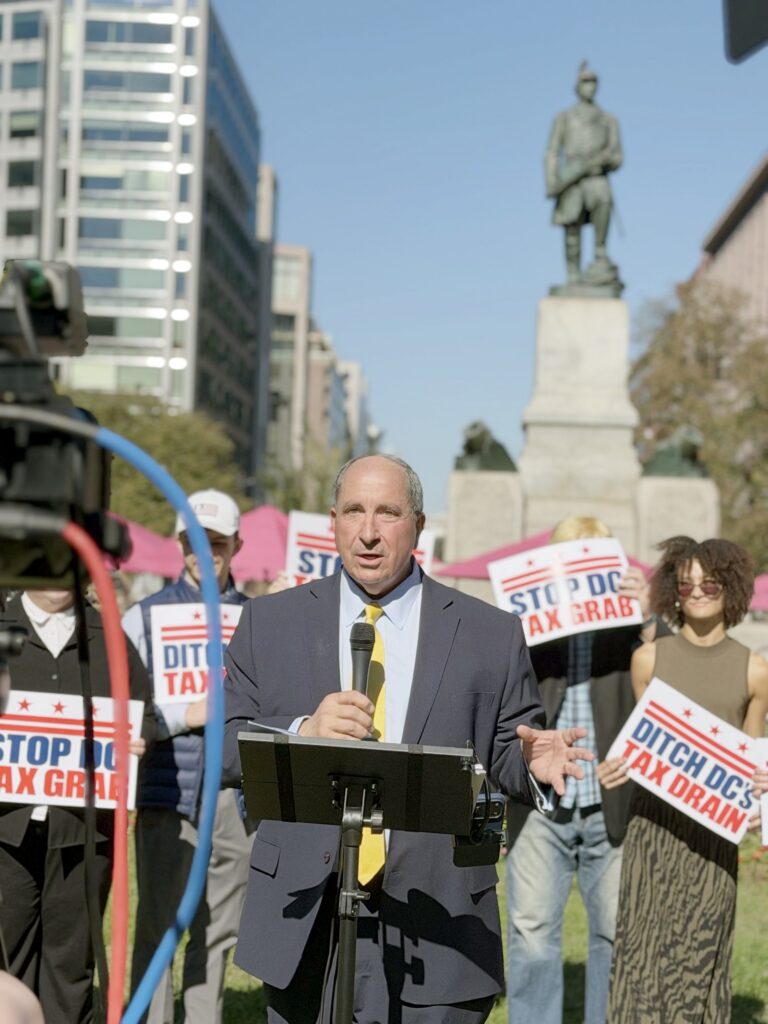
A tax press conference, about a week before Election Day.
The statement Fredericks gave The District Feed went further, and it wasn’t about taxes. It was about D.C. home rule, the 1973 law that lets D.C. elect its own mayor and Council.
What Fredericks said
“This isn’t a revenue problem. It’s a spending problem,” Fredericks said in the party’s Oct. 19 release, which calls for cutting waste, freezing new spending, growing the tax base, letting residents deduct rent on a primary residence, and suspending the gas tax for six months.
In his statement, he credited President Trump with an “urban renaissance” he called “spectacular,” and said D.C. is now “the safest, cleanest and most beautiful city in America.”
He added: “If the Leftist Democrats attempt to unravel his gains, I predict he’ll pull home rule.”
“Cleanest” and “most beautiful” are matters of taste, so we’ll leave those to you. “Safest” and the home rule prediction we can check. First, the taxes.
Where the taxes stand
At an Oct. 16 hearing, Council members weighed a business activity tax, a tax on luxury second homes, property tax changes and Ward 1 Council member Brianne Nadeau’s 3% surtax on investment income for high earners.
On the business tax, Nadeau asked, “Why should the tax burden be more heavy on D.C.-owned businesses than out-of-state businesses?”
Former Mayor Anthony Williams urged caution: “I ask you not to risk giving them a reason to leave.”
At-large Council member Christina Henderson said, “We can’t continue to ask residents to pay for more, and then we deliver less.”
Nothing has passed. Council Chair Phil Mendelson doesn’t expect a vote on a tax increase this fall.
Now some Stats 101 on the money. The DC Policy Center, a think tank, found that from 2019 to 2026 spending rose 51% and personal income rose 47%. That’s four percentage points over seven years, and the testimony doesn’t say whether the figures are adjusted for inflation. As for new revenue, Nadeau’s surtax is pegged at about $200 million in its first year, partly because it would reach back to 2026 income. A tax analyst who testified put a typical year closer to $139 million. A one-year number and a recurring one aren’t the same thing.
The crime numbers
The Metropolitan Police Department’s crime data page showed 84 homicides as of Oct. 26, down 26% from 113 at the same point last year. Total violent crime: 2,344, up 12%. The figures are preliminary.
So is D.C. safer? On homicides, the page says yes. On violent crime overall, it says no.
Correlation, meanwhile, still isn’t causation. U.S. Attorney Jeanine Pirro has credited the federal surge that began in August 2025. But D.C. homicides had already fallen from 274 in 2023 to 187 in 2024, and cities without Guard deployments saw big drops too. A Niskanen Center study cited in that analysis found about 24% less opportunistic property crime where Guard troops were visible, and no detectable effect on violent crime.
And one footnote for everybody’s numbers, including the ones above: in July, D.C.’s inspector general described a “prolonged, systemic breakdown” in the internal controls behind police crime statistics.
As for “safest,” we didn’t find a ranking that says so. WalletHub’s 2026 list, which mixes crime with things like disaster risk and finances, put D.C. 165th of 182 cities. That’s one ranking, and it measures more than crime.
Who can end D.C. home rule
Under the Constitution, Congress has the final say over D.C., and the Home Rule Act lets Congress step back in “at any time.” Repealing home rule takes Congress, not just the president.
A president has a narrower lever. In August 2025, Trump used a section of the Home Rule Act to take command of D.C. police, a power that lasts 30 days unless Congress extends it. It was set to expire Sept. 10, and Axios reported that House Speaker Mike Johnson said Congress wouldn’t vote to extend it.
Sen. Mike Lee’s BOWSER Act, which would repeal home rule outright, has sat in committee since February 2025, according to bill trackers. In June, before the primary, Trump said that if Janeese Lewis George won the mayor’s race, “maybe we’d take back Washington and run it on the federal basis.” Lewis George, the Ward 4 Council member, replied that threatening home rule over how residents vote “is an attack on democracy itself.” She won the Democratic primary days later.
A repeal takes an act of Congress, and none has passed.
What’s next
The Council’s hearing record on the tax proposals closes at 5 p.m. Friday, Oct. 30. Early voting runs through Sunday, Nov. 1, and Election Day is Nov. 3.
Disclosure: John Fredericks, the DCGOP’s Ward 2 chair, is the author’s father, and the author works for the John Fredericks Media Network, which published the video of the press conference linked above.
Leave a comment